ux
visual
systems
digital/physical
transforming a static, cluttered menu system into a dynamic digital experience for 1,000+ locations
Culver's needed a system that could think: one that updated overnight, surfaced the right items at the right moment, and worked across entirely different physical environments.
team & timeline
background & challenge
A menu doing too much, for too many people, across too many screens.
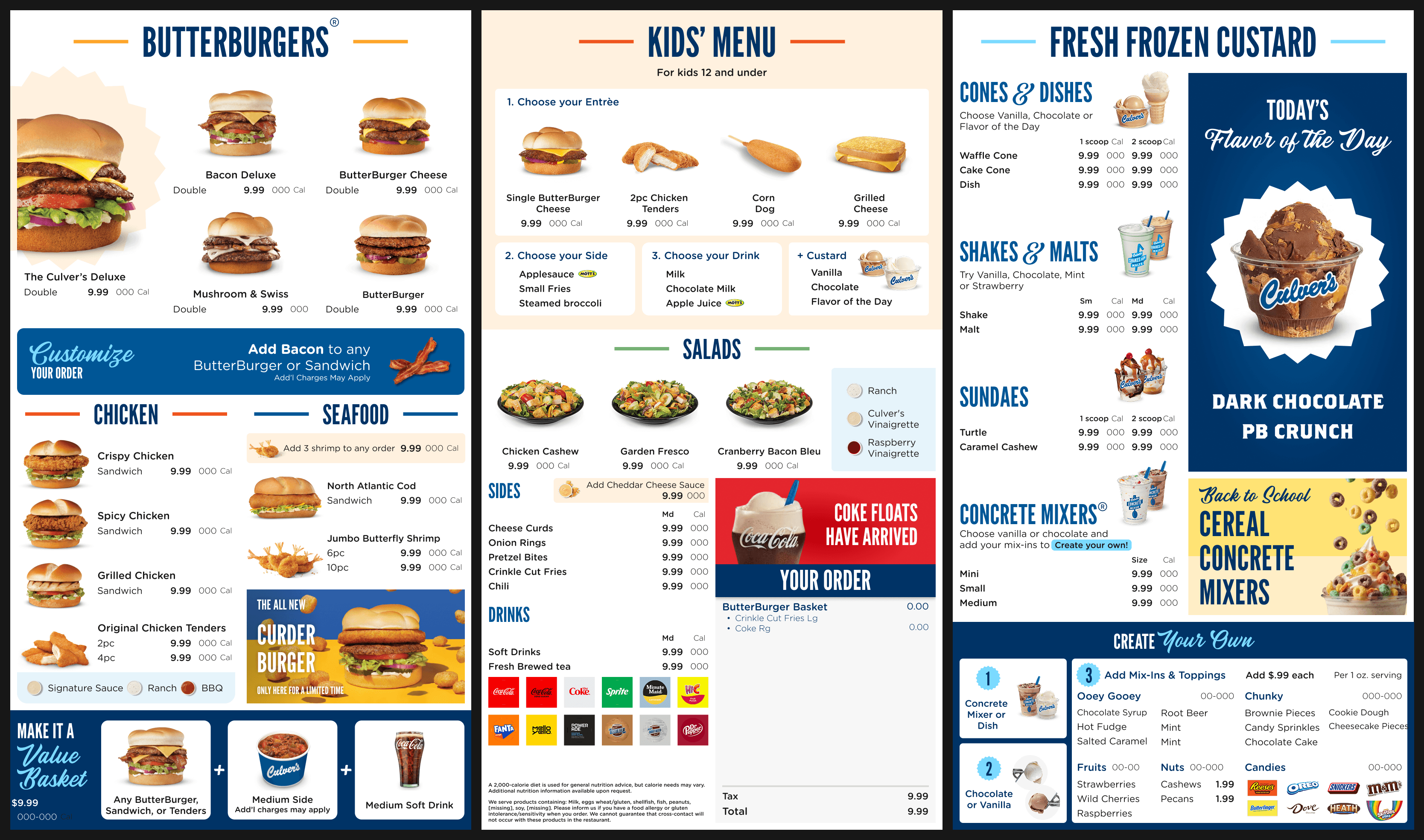
Culver's had scaled past 1,000 locations on a system that couldn't keep up. Menus were overwhelming and cluttered, with no hierarchy guiding attention toward high-margin or limited-time items.
The problem was more complex than it looked: indoor and drive-thru environments have fundamentally different constraints, from viewing distance and time pressure to how decisions actually get made. And the menu had to work for two very different customers at once: the regular who already knows what they want, and the new guest who needs help figuring it out fast. Getting the hierarchy wrong meant losing both.
After visiting 12 high-volume locations and talking to 28 guests, a few things came up consistently: kids drive a lot of the ordering decisions, regulars are open to trying new things but just never notice them, and the drive-thru and in-store environments have pretty different constraints in terms of viewing distance, time pressure, and how decisions actually get made.
approach
Visual and UX design ownership across a multi-screen, multi-environment system.
I owned all visual and UX design decisions on the project, working alongside a strategy director who led the research and business framing. The team conducted site visits and interviewed 28 guests across high-volume locations to understand real ordering behavior, then designed and tested two competing layout directions, presenting both to stakeholders with tradeoffs clearly laid out.
The bigger body of work was the design system: a type hierarchy built for 10 to 14 foot viewing distances, a component library with three tiers of item treatment, and a modular architecture that lets Culver's update content across 1,000+ locations without touching the layout. I also rebuilt all final boards in Figma to 100% component consistency before handoff, and contributed to the analytics instrumentation strategy to support future A/B testing and personalization.
impact
Pilots are live, with nationwide rollout by 2029.
First pilot locations went live in October 2025. Updates that used to take 5 to 8 weeks now happen overnight, which means Culver's can respond to pricing changes, promos, and seasonal items instantly for the first time. The modular system laid the foundation for a cloud-native, data-driven platform built to scale, test, and iterate across every location in the chain.